
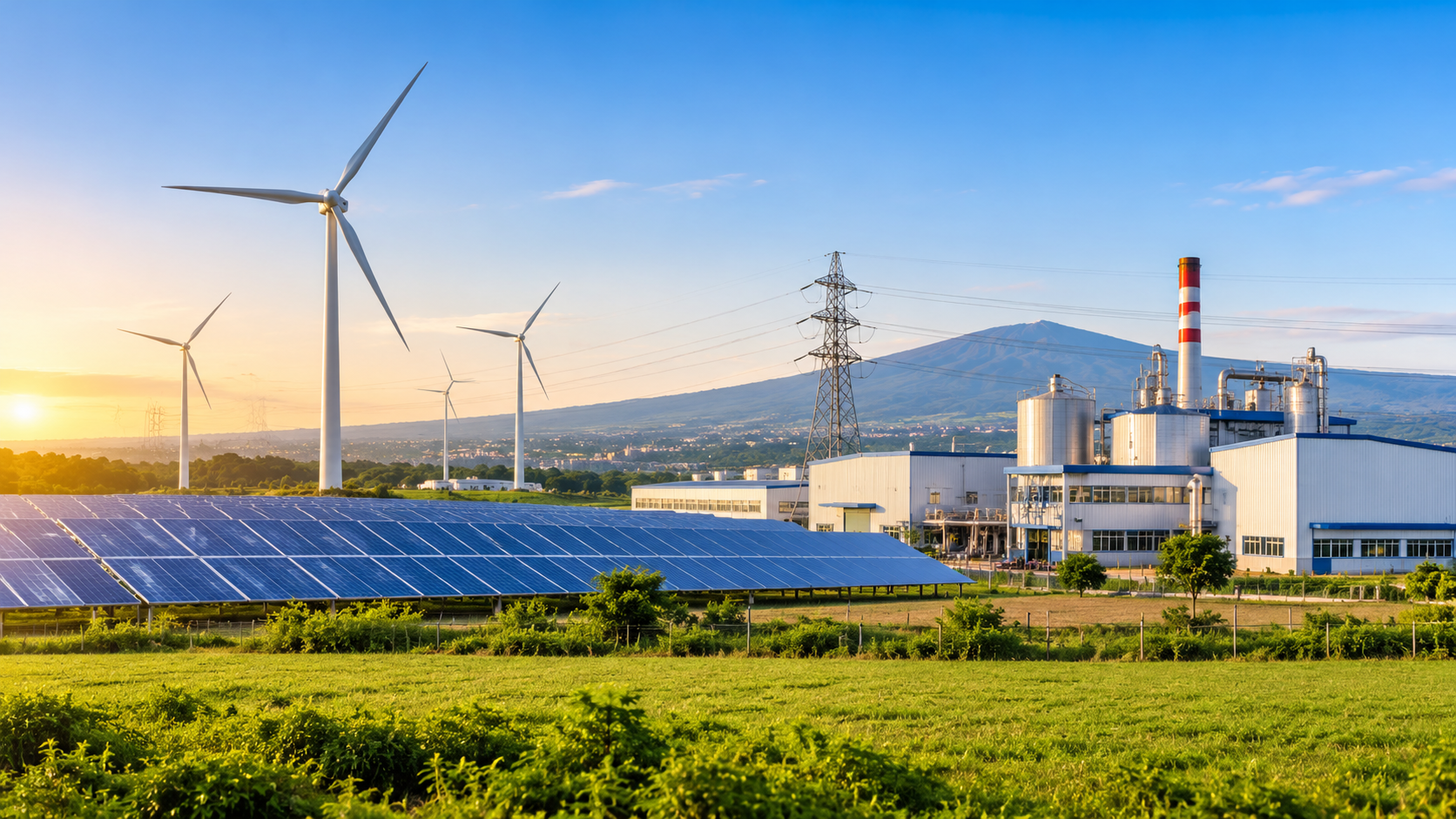
Why Kenya must stop confusing clean electricity with sufficient electricity—and why solar investors, smart regulation, and innovative financing could power our next economic revolution.
By Edward Kinyanjui
Founder & Managing Director, Plexus Energy Limited
Kenya has earned itself an enviable reputation in renewable energy. We proudly tell the world that more than 80% of our electricity is generated from renewable sources. Our geothermal resources are the envy of many nations, our wind farms have become symbols of progress, and our abundant sunshine offers enormous untapped potential.
That is worth celebrating.
But there is an uncomfortable question we rarely ask: What good is having one of the greenest electricity systems in the world if we cannot produce enough power to industrialize our economy?
It’s like celebrating that your car is extremely fuel-efficient, only to discover its engine is too small to climb the hill ahead.
Kenya’s energy challenge is no longer simply about how green our electricity is. It is about how much we produce, how reliably we deliver it, how affordably we price it, and whether we can expand supply fast enough to support our economic ambitions.
Two recent developments illustrate why we urgently need to rethink our national conversation about energy.
In September 2026, the Energy and Petroleum Regulatory Authority (EPRA) published Gazette Notice No. 15188, introducing provisions on electricity dumping and net metering.
Some public commentary interpreted the changes as a government crackdown on solar installations. That interpretation misses an important distinction.
The regulation does not prohibit businesses or households from installing solar systems to generate electricity for their own consumption.
Instead, it addresses the unauthorized injection of electricity into Kenya Power’s network.
Under the Gazette Notice, electricity exported without prior written authorization attracts a surcharge based on the applicable base tariff. The same notice recognizes approved net-metering arrangements, under which qualifying consumers can export surplus renewable electricity and receive an energy credit equivalent to 50% of the exported units.
To understand why this matters, we must appreciate that the national electricity grid is not simply a giant extension cable.
It is a carefully balanced system in which electricity generation and consumption must remain aligned. Voltage, frequency, protection systems and power flows must be managed continuously.
Imagine a road on which motorists suddenly decide to drive against traffic because they have purchased more powerful vehicles. The problem is not the vehicles. It is the absence of coordination.
Likewise, uncontrolled electricity exports from poorly designed or unapproved solar installations can create technical challenges, particularly on local distribution networks. These include voltage instability, reverse power flows, protection coordination problems and potential safety risks for maintenance personnel.
In my view, EPRA is right to insist on technical compliance and approved grid connections. However, regulation must be accompanied by clear procedures, reasonable approval timelines, accessible net-metering arrangements and consistent enforcement.
Solar installers must also take responsibility for professional system design, protection equipment, appropriate inverter settings and regulatory compliance.
For customers who only wish to consume their own solar electricity, properly configured zero-export systems offer a practical solution.
Kenya should not discourage solar investment. It should encourage more solar installations that are safe, professionally engineered and properly integrated into the wider electricity system.
Because the bigger problem is not that Kenya has too much electricity.
It is that we have nowhere near enough.
According to EPRA’s 2026 Energy and Petroleum Statistics Report, Kenya had approximately 3,263 MW of interconnected installed generation capacity as at June 2026.
Including captive generation and off-grid systems, total installed capacity stood at approximately 3,987 MW.
That means Kenya’s total electricity-generating capacity, across these categories, was just under 4 gigawatts.
Now consider the scale of other economies.
Egypt has approximately 61 GW of installed electricity capacity. South Africa has around 65 GW. Türkiye has exceeded 120 GW. Germany has more than 290 GW, while China has surpassed an astonishing 3,890 GW.
Even allowing for differences in population, economic size and electricity demand, the comparison should make us uncomfortable.
South Africa has approximately sixteen times Kenya’s total installed capacity. Egypt has fifteen times as much. Türkiye has more than thirty times our capacity.
China operates on an entirely different scale.
Of course, installed capacity is not the same as electricity actually generated. A solar panel, geothermal plant, hydroelectric station and coal-fired plant all have different operating characteristics. What matters ultimately is dependable, affordable electricity delivered to consumers.
Nevertheless, these figures reveal the enormous difference in the scale of energy infrastructure supporting industrial economies.
We cannot realistically aspire to become a major manufacturing, processing, technology and logistics hub while remaining a small electricity producer.
Industrialization is not powered by ambition alone.
It requires megawatts. Thousands of them.
Consider the proposed Microsoft–G42 data center development in Olkaria, announced as part of Kenya’s ambition to become a regional digital technology hub.
Reports in 2026 indicated that the project’s larger development ambitions could require up to 1 GW of electricity, placing considerable pressure on Kenya’s relatively small generation system. The project has experienced significant uncertainty, although reports of its definitive cancellation have been disputed.
The lesson remains powerful.
A single large technology investment could potentially require electricity equivalent to almost a third of Kenya’s interconnected installed capacity.
Imagine the opportunities associated with such an investment: construction, cooling technology, electrical engineering, fibre infrastructure, artificial intelligence, digital services and the many businesses that would support them.
Now imagine losing similar opportunities simply because we cannot guarantee adequate power.
Our Standard Gauge Railway offers another illustration. Kenya originally envisaged electric traction as part of its long-term railway development, yet the railway operates using diesel locomotives. Electrification involves substantial investment in traction infrastructure, transmission and railway systems, alongside a dependable electricity supply.
Meanwhile, Kenya has developed electricity import arrangements with Ethiopia, a sensible example of regional power trading that also underlines the importance of building a stronger domestic supply system.
Importing electricity is not inherently a failure. Countries around the world trade energy to improve efficiency, manage shortages and strengthen regional cooperation.
But regional imports should complement a growing domestic electricity sector, not become a substitute for expanding our own productive capacity.
The proposed Dangote refinery in Lamu provides another striking example.
Public reports indicate plans for approximately 1,000 MW of power generation associated with the refinery, potentially leaving 500 MW available for sale into Kenya’s electricity system.
Think about that.
A single industrial development is contemplating electricity generation equivalent to roughly a quarter of Kenya’s existing interconnected capacity.
The reported generation would use petroleum coke, raising legitimate environmental questions. It highlights a difficult choice: when clean, dependable and competitively priced electricity is not available at sufficient scale, industrial investors may develop their own generation solutions, including more carbon-intensive alternatives.
That should challenge us to accelerate investment in renewable generation, energy storage and transmission infrastructure.
The answer is not to abandon our green ambitions.
It is to make clean electricity abundant enough that businesses do not have to choose between investment and sustainability.
For years, discussions around privately installed solar systems have sometimes created the impression that electricity generated behind a customer’s meter represents lost business for the national utility.
That is a narrow way of looking at the issue.
When a factory, hospital, university, hotel or commercial building installs solar generation, it reduces the electricity it needs to draw from the grid during solar-producing hours.
This can free up generation and network capacity for other consumers, reduce pressure on infrastructure and support business competitiveness.
Where properly authorized, surplus electricity can also become a resource for the wider grid.
According to EPRA’s latest statistics, Kenya’s captive solar photovoltaic capacity reached approximately 373 MW in June 2026, growing by more than 24% over the preceding year.
That is significant private investment in productive energy infrastructure.
These systems do not automatically replace the need for national grid expansion. Solar output varies with weather and time of day, and many businesses still require dependable grid supply or battery storage.
But the wider economic contribution is undeniable.
At Plexus Energy Limited, we have spent the last sixteen years helping customers adopt solar energy, energy storage and power management solutions.
We have witnessed first-hand how well-designed energy systems can improve operating efficiency, manage electricity costs and enhance business continuity.
A factory that reduces its electricity costs becomes more competitive. A hospital with reliable backup power can protect critical services. A school that lowers its energy expenditure can redirect resources toward education.
And an enterprise that saves money on electricity can reinvest in machinery, expansion and employment.
These are not simply solar projects.
They are investments in Kenya’s productive economy.
One of the biggest barriers to solar adoption has historically been the upfront investment.
A business may understand that solar will reduce its operating costs but still struggle to allocate capital to purchase the system.
That is an opportunity for financial innovation.
At Plexus Energy, we are increasingly moving beyond the traditional model of selling equipment upfront.
We now offer qualifying customers zero-deposit, customized hybrid solar solutions, structured around their electricity consumption patterns, financial requirements and projected savings.
Rather than simply asking customers how many solar panels they want, we ask more important questions.
How much electricity does the business consume? At what time of day? What are its peak demand characteristics? How much backup power is necessary? What savings are realistically achievable? And how can the investment be structured so that it pays for itself over time?
Our approach is based on engineering analysis, financial modelling and return on investment.
Where commercially viable, a customer can adopt solar without making an upfront capital deposit, with payments structured around the savings and cash flows generated by the solution.
Naturally, every project must undergo technical assessment, credit evaluation and financial structuring. There is no universal solution.
The objective is simple: Make solar adoption a business decision driven by financial returns, rather than a capital expenditure burden.
After all, electricity bills have a remarkable habit of arriving every month without fail. We might as well put some of that money to work building an asset!
If Kenya is serious about industrialization, energy financing must become a national economic priority.
Traditional financing models often require substantial collateral, short repayment periods and upfront equity contributions that discourage otherwise viable projects.
Yet a well-structured solar or hybrid energy system has measurable benefits, predictable operating characteristics and potential long-term savings.
Banks and other financiers should increasingly evaluate these projects on their cash-generation potential rather than relying solely on conventional collateral.
We need more innovation through energy leasing, pay-as-you-save arrangements, power purchase agreements, asset-backed finance, credit guarantees and blended financing structures.
Development finance institutions, commercial banks, pension funds and private investors all have roles to play.
The government can accelerate adoption by creating predictable policies, streamlined approvals and appropriate incentives for locally implemented renewable energy projects.
Importantly, Kenyan engineering and renewable energy companies should not be reduced to installation subcontractors while the most attractive financing and long-term ownership opportunities flow elsewhere.
Local companies understand local operating conditions, customers, distribution networks and market risks.
They should be supported to develop, finance, own, operate and maintain energy assets.
This would create more opportunities for Kenyan electricians, engineers, technicians, manufacturers, project managers, financiers and young entrepreneurs.
It would also help retain a greater share of the economic value created by renewable energy investments within Kenya.
An energy transition that produces clean electricity but fails to build local enterprises and create quality employment is a missed opportunity.
Kenya’s next chapter must combine three objectives: energy abundance, affordability and sustainability.
We should accelerate geothermal development, expand solar and wind installations, invest in battery energy storage, modernise transmission and distribution networks, and improve grid flexibility.
We must also strengthen technical standards and make it easier—not harder—for responsible private investors to participate.
The future electricity system should not be viewed as a contest between large utilities and private solar investors.
It should be an ecosystem in which public utilities, independent power producers, distributed generators, investors, and consumers contribute to the country’s energy security.
Most importantly, we must begin measuring success not only by the percentage of electricity that is renewable, but also by the amount of affordable, dependable electricity available to power our economy.
We should be asking how many factories we can support, how many data centers we can attract, how many industrial jobs we can create, and how competitively our businesses can operate.
Kenya has the sunshine. We have the wind. We have exceptional geothermal resources. We have an entrepreneurial population and a growing pool of engineering talent.
What we need now is the ambition, innovation, financing, and regulatory clarity to turn these advantages into abundant electricity.
The opportunity is enormous.
We should aspire to a Kenya where industries do not relocate because of electricity costs, investors do not hesitate because of power constraints, and young people find employment in an expanding productive economy.
Let us stop celebrating only how green our electricity is and start celebrating how much green electricity we can produce.
Because a country cannot industrialize on potential alone.
And while sunshine may be free, turning it into prosperity requires investment.
Edward Kinyanjui is the Founder and Managing Director of Plexus Energy Limited, a Kenyan energy solutions company established in 2010, specializing in solar PV, hybrid power systems, battery energy storage, and power infrastructure solutions.


