

Kenya is facing an uncomfortable energy moment. President William Ruto has publicly admitted that the country has been forced into deliberate power rationing(load shedding)-switching off supply to some areas between 5pm and 10pm to keep the national grid stable, while demand outstrips supply. He told Kenyans that the country needs significant investment (roughly KSh1 trillion) to boost capacity toward 5,000 MW and ease the shortfall.
That admission should be a wake-up call for every business owner. Kenya’s total installed capacity sits around 3.8 GW (3,840.8 MW) — a number that underlines how tight the balance between supply and demand has become.
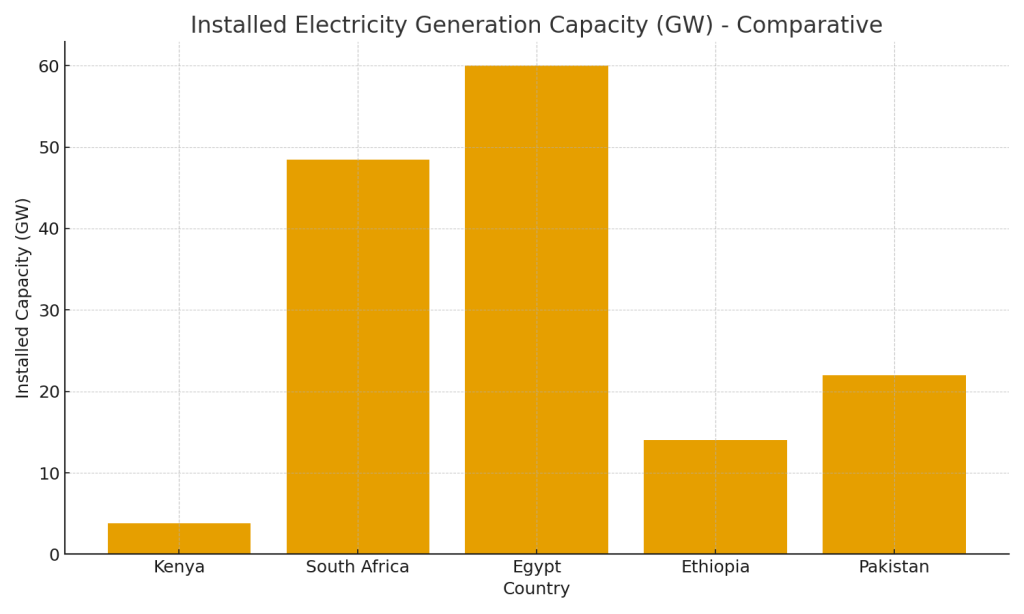
Seen in context, the opportunity — and the risk — are obvious. Regional peers have much larger systems: South Africa (~48.5 GW) and Egypt (~60 GW) operate with far more headroom, while Ethiopia and Pakistan have pursued very different growth paths. Pakistan’s extraordinary recent rush into solar — importing roughly 22 GW of panels in a short span — shows how fast solar can scale when policy, finance, and private demand align.
When South Africa confronted its own load-shedding crisis in 2020, it doubled down on renewables; the country has since added more than 10 GW of wind and solar capacity, helping to blunt some of the worst outages and diversify supply.
That fast deployment is an object lesson: distributed solar + storage can be deployed quickly at business scale — far faster than building new baseload plants.
• Start with a load audit: know your peak kW, critical circuits (IT, refrigeration, production lines), and night-time needs.
• Mix PV + storage: daytime generation lowers your grid draw and charges batteries; storage provides cover through evening rationing windows.
• Consider hybrid setups: keep a smaller, well-maintained genset for emergency redundancy, but size it far smaller than today — saving fuel and emissions.
• Explore financing: leases, power purchase agreements (PPAs), and green loans can reduce upfront pain and make projects cash-positive from month one.
President Ruto’s admission highlights a policy reality: Kenya must either rapidly expand centralized generation or accelerate decentralized solutions — or both.
Given the speed at which solar has scaled in countries like Pakistan, and the rapid addition of renewable capacity in South Africa after their 2020 crisis, solar is not just a climate solution — it’s an emergency triage for the economy.
Load-shedding is painful — and for businesses it’s expensive. The good news is that practical, bankable, fast-deploying solar + storage systems exist today and are proven internationally to close generation gaps quickly. President Ruto’s comments should be read as a clear market signal: grid stability cannot be assumed — businesses must act to secure their own power supply. Going solar is no longer only an environmental statement; it’s a risk management and growth strategy.


