

Solar as a Service transforms ROI and cash flow for businesses and homeowners – making solar energy a real game changer without upfront costs.

Blog post by Edward Kinyanjui
For years, solar was viewed as just another product—a set of panels, an inverter, and a one-off installation. But today, the conversation has shifted. Solar is no longer simply about selling equipment; it’s about delivering energy as a service. And in this new model, the return on investment (ROI) and cash flow analysis are the real decision-makers, especially for commercial and utility-scale projects.
At Plexus Energy Ltd, we’ve seen first-hand how clients no longer ask, “How much is the system?” but instead, “How much will I save, and how fast will I recover my investment?” Let’s break it down with a real example.
Cash flow is the lifeline of any solar project. It answers the simple but crucial question: Does the project generate more savings or revenue than it costs to operate?
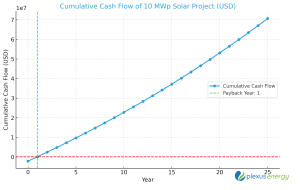
In a recent 10 MWp commercial solar project we designed and reviewed, the numbers were telling:
Initial Investment: ~USD 2.18 million
Annual Generation: ~14,600,000 kWh
Annual Savings (Grid Tariff @ USD 0.16/kWh): ~USD 2.34 million in avoided electricity costs
Positive Cash Flow: Achieved from Year 1, with cumulative payback in under 5 years
? Tip: A positive annual cash flow means the system is not only self-sustaining but also generating net value year after year.
ROI is the ultimate metric investors, CFOs, and boards look at before greenlighting a project. It measures the speed and size of returns relative to the capital invested.
For the same 10 MWp project, the payback was just under 5 years, while the project continues to generate free cash flows for the remaining 20 years of its Power Purchase Agreement (PPA) term.
Simple Payback: < 5 years
ROI Across 25 Years: > 300% cumulative return
IRR (Internal Rate of Return): Significantly above local borrowing rates, making it highly bankable
? Tip: A well-structured solar project often delivers ROI in under 5 years, with pure profit for the remaining 20+ years.
Solar may be low-maintenance compared to traditional power plants, but O&M still plays a critical role in long-term returns.
In the reviewed project, annual O&M costs were budgeted at ~USD 109,000, equivalent to about 5% of the project’s cost. This included inverter maintenance, periodic cleaning, and performance monitoring.
Factoring in O&M ensures stable output and predictable ROI throughout the 25-year project life.
The solar conversation has shifted permanently. No longer do businesses buy “solar panels”—they buy energy savings, financial predictability, and sustainability impact.
At Plexus Energy Ltd, we design proposals that include not just system sizing and equipment, but also ROI analysis, financing terms, and eco-metrics for ESG compliance. Because in today’s world, solar is not just an investment in equipment—it’s an investment in cash flow certainty and long-term resilience.


